
Champi: what infrared colours reveal
ESA released a Sentinel-3 image from 21 October. Colours represent brightness temperature, not the typhoon’s natural appearance.
RockGeo Editorial · Published on
Event date: 10/21/2026 · Source date: 10/30/2026
Sources accessed on 10/31/2026, 15:03 GMT
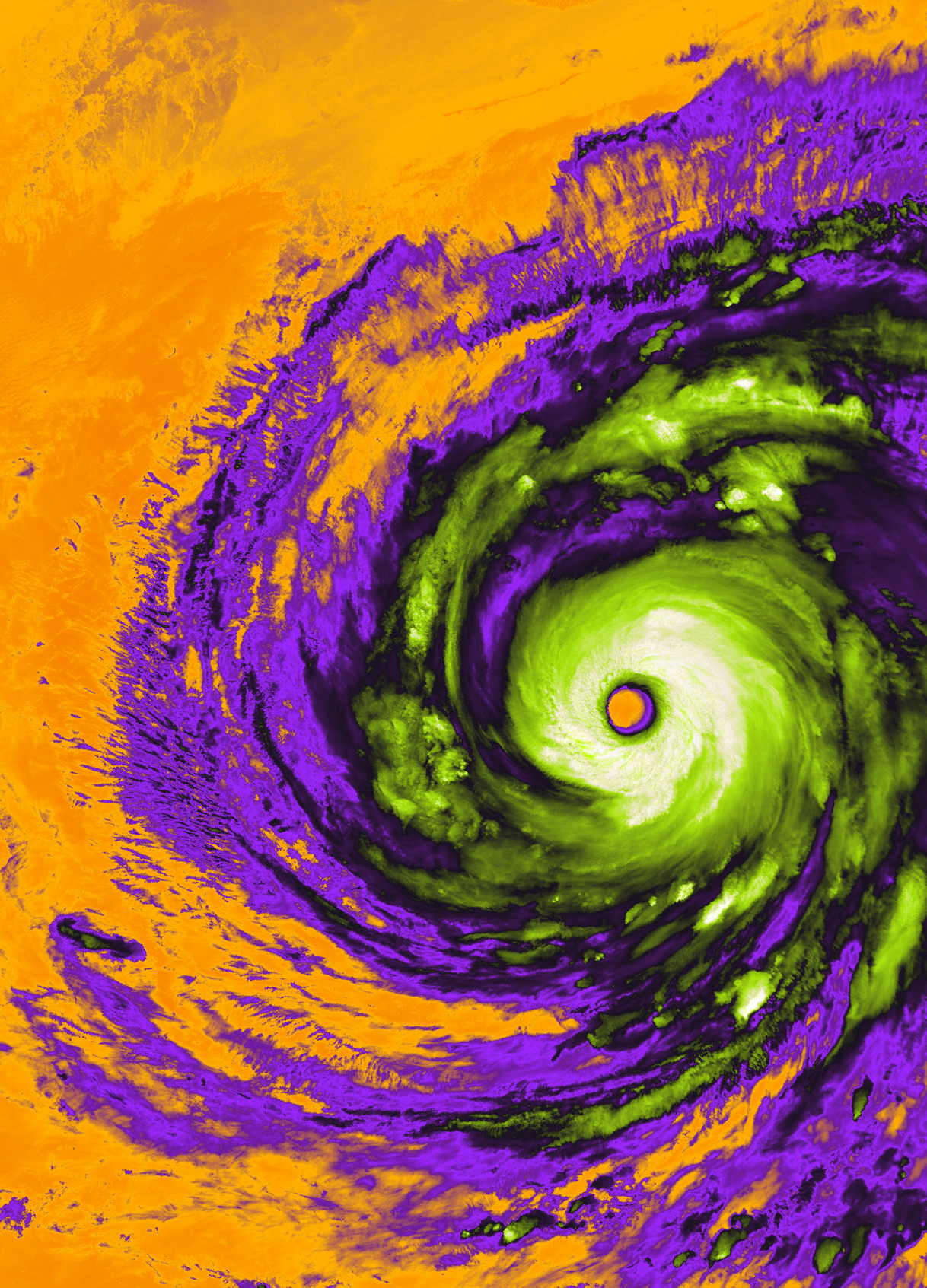
contains modified Copernicus Sentinel data (2026), processed by ESA · CC BY-SA 3.0 IGO
The European Space Agency (ESA) published an image of Super Typhoon Champi on 30 October 2026, acquired by Copernicus Sentinel-3 on 21 October. The scene is in the western Pacific near Taiwan and the Philippines. Its focus is the storm’s eye, described by the agency as approximately 50 km across.
The SLSTR radiometer measured thermal-infrared radiance. The composition assigns colours to brightness temperature inferred from that radiation, which may differ from actual physical temperature. Orange, purple, green and white therefore form a data visualization; they are not the colours a person would see in clouds and ocean.
In the published interpretation, green, white and light-grey tones correspond to cold clouds with values down to −70 °C. Purple indicates approximately −30 to −15 °C; orange areas over land and ocean average around 25 °C. These ranges explain this image’s particular palette rather than providing a uniform thermometer for the entire scene.
ESA instrument documentation states that SLSTR uses dual-view observations and provides 500 m spatial resolution in visible, near-infrared and shortwave-infrared channels, and 1 km in thermal channels. This distinction matters when interpreting detail: enlarging a file on screen does not create observations finer than the sensor’s measurements.
Sentinel-3 also carries ocean-colour and altimetry instruments measuring different properties. A thermal composition should not be confused with all those products combined. Geoscientific interpretation requires identifying instrument, variable and processing before comparing scenes. Here, official framing and colours are preserved, separating acquisition on 21 October from later publication.