
Teghaza 001: a window into Mars’ ancient crust
Found in Mali, the meteorite preserves minerals at least 4.1 billion years old. New analyses connect crust formation and alteration by water.
RockGeo Editorial · Published on
Event date: 10/29/2026 · Source date: 10/29/2026
Sources accessed on 11/01/2026, 15:03 GMT
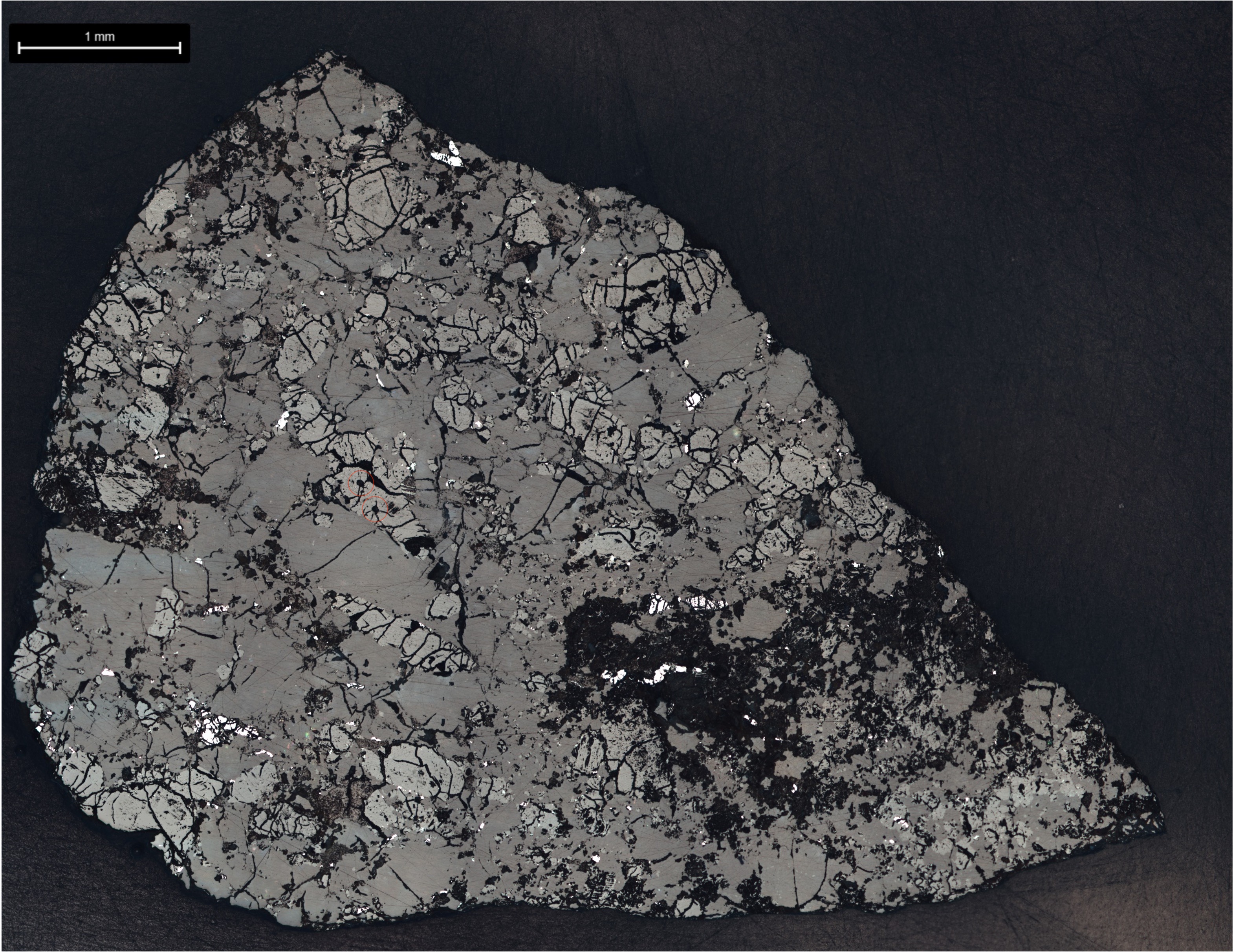
NASA/JPL-Caltech · JPL Image Use Policy — use with credit
A study led by Yang Liu of the Jet Propulsion Laboratory (JPL) characterizes a rare fragment of Mars’ ancient crust: the meteorite Teghaza 001. Announced by NASA/JPL on October 29, 2026, and published in Science, the research examines an approximately 800 g rock found in the Sahara in Mali in 2022. Results indicate an age of at least 4.1 billion years.
University of New Mexico researchers identified its Martian origin by comparing oxygen isotopes with other Mars meteorites. Its mixture of igneous minerals records cooling magma and later interaction with subsurface water. The mineralogy also matches orbital observations of the southern highlands, but does not establish an exact source location.
UCLA reports that its SIMS ion microprobe laboratory performed the uranium-lead dating that established the meteorite’s age. Its statement highlights mineralogy and geochemistry unlike earlier Martian samples. This expands the available record for investigating the planet’s early history, while a separate Science Advances paper addresses components of its ancient hydrosphere preserved in the rock.
JPL also describes in-situ rubidium-strontium dating developed by François Tissot’s team at Caltech. The technique analyzes individual grains in a section smaller than a fingernail, preserving material for future studies. According to the release, water alteration occurred around 4.1 billion years ago, suggesting earlier formation: formation age and alteration age represent different stages of geological history.
The official image shows a reflected-light section used to locate minerals before other analyses. It is not an image of Mars’ surface. NASA’s documentation distinguishes igneous minerals, shock-modified plagioclase and fine carbonate, sulfate and clay alteration formed on Earth. Thus, not all visible alteration should be attributed to Martian water. The 1 mm scale and full framing have been retained to preserve this context.