
Jake Creek: reading a gold intercept requires care
Headwater reports 1.34 g/t gold over 46.33 m. The downhole interval includes missing core and does not establish true thickness.
RockGeo Editorial · Published on
Event date: 10/28/2026 · Source date: 10/28/2026
Sources accessed on 10/28/2026, 20:02 GMT
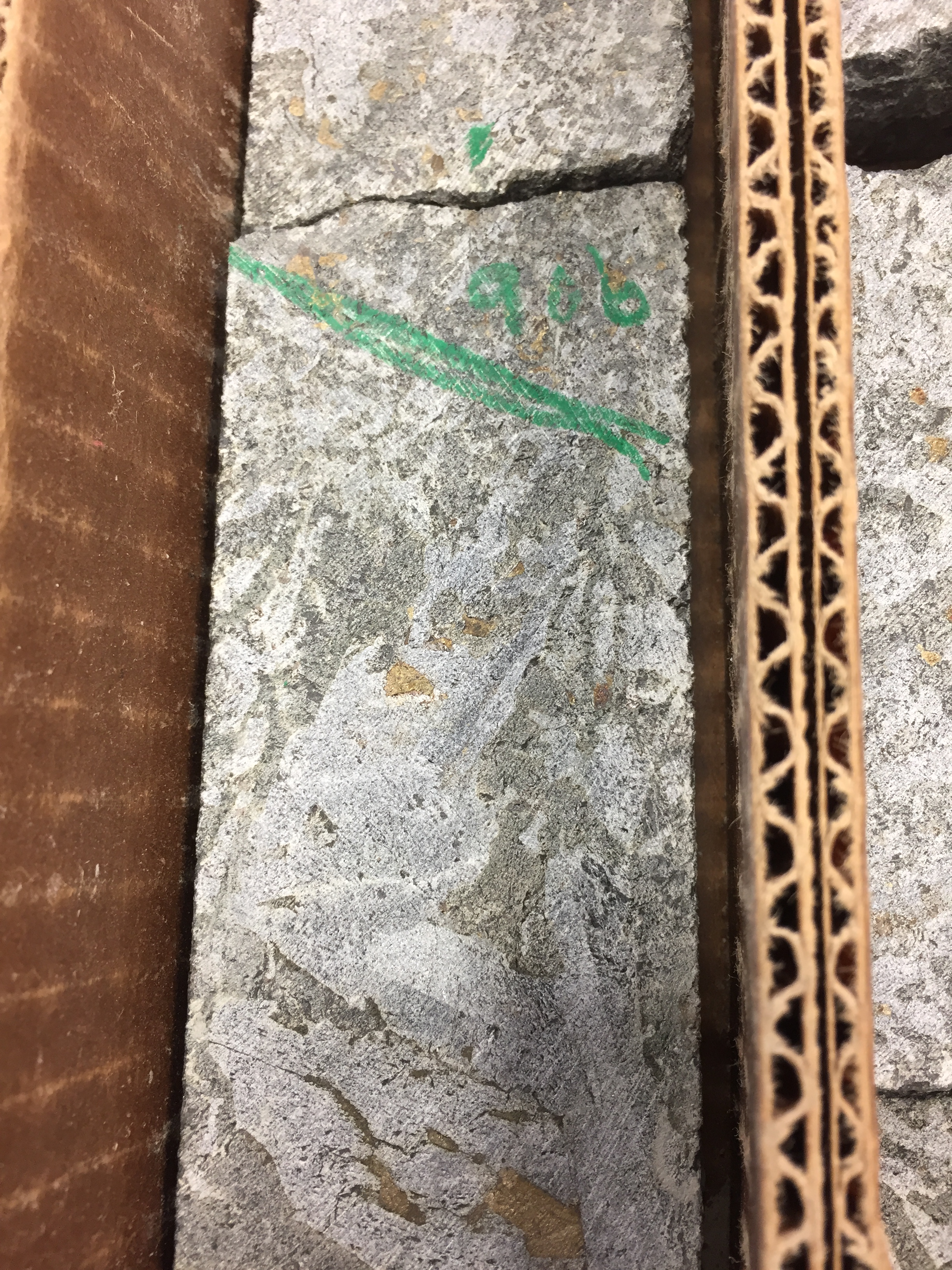
USGS / Michael Zientek · Public Domain
Headwater Gold announced initial Jake Creek results in Nevada, United States, on 28 October 2026. Hole JC26-01 returned 1.34 grams of gold per tonne over 46.33 metres, starting at a downhole depth of 277.98 metres. This is a drill-hole length; true thickness remains unknown.
The composite includes 2.29 metres of unrecovered core. The company assigned a null grade to that section in its calculation, but its actual gold content is unknown. The distinction matters: a value used to calculate an average cannot replace a recovered and analysed sample. The campaign totalled 3,574 metres in eight holes across five target areas.
The company describes silicified fault breccias, hydrothermal brecciation and quartz-carbonate veins with epithermal textures. In outlying exploration holes, alteration and trace elements support its interpretation of a broad hydrothermal system, but no significant gold intercepts were encountered. Analysis was attributed to ALS in Reno, using a 30-gram fire assay with ICP-AES finish, method Au-ICP21.
ALS technical documentation explains the method: a pulverised, homogenised aliquot is mixed with flux and heated above 1,000 °C. Gold is collected into lead; an oxidising stage removes the lead, leaving precious metals for determination. The Au-ICP21 option uses 30 grams and ICP-AES. Matrix controls and quality checks form part of the laboratory’s described procedure.
Results remain outstanding, including the second Discovery Corridor hole. OceanaGold’s continued participation at Jake Creek depends on its review of pending assays. Technical information was reviewed by Joshua Carron, a Headwater executive and therefore not independent. This is corporate exploration disclosure; the isolated interval does not demonstrate a mineral reserve or economic viability.